Predictor Based on Complete Subgraphs for Consensus Problems With Communication Delay
DOI:
https://doi.org/10.33478/j-technos.v4i1.1Keywords:
consensus problems, delay, prediction, subgraphsAbstract
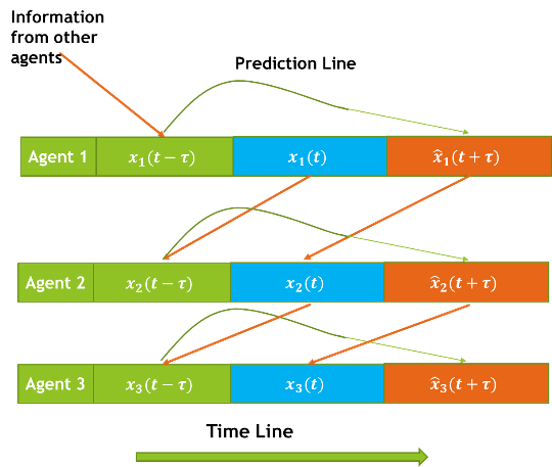
Consensus problems need communication between two or more agents. The existence of time delay in communication makes every agent doesn’t get the real-time states of the other agents. The main problem of delay system is the response starts slowing down and oscillating when the gain is increasing. This paper proposes a predictor-feedback that reduces the effect of time delay. The predictor itself utilizes the complete subgraphs. Analytically the result generates faster response compared to the system without the predictor. Then, the proved solution is supported by a numerical solution.
References
R. Olfati-Saber and R. M. Murray, “Consensus problems in networks of agents with switching topology and time-delays,” IEEE Trans. on Automatic Control, vol. 49, no. 9, pp. 1520–1533, 2004.
L. Moreau. Stability of multi-agent systems with time-dependent communication links. IEEE Trans. on Automatic Control, 2005, 50(2): 169–182.
R. Olfati-Saber, R. M. Murray. Consensus protocols for networks of dynamic agents. Proc. of the American Control Conference, Colorado, USA, 2003: 951–956.
W. Xing, Y. Zhao, and H. R. Karimi, ‘‘Convergence analysis on multiAUV systems with leader-follower architecture,’’ IEEE Access, vol. 5, pp. 853–868, 2017.
S. Izumi, S. I. Azuma, and T. Sugie, “ On a relation between graph signal processing and multi-agent consensus,” in Proc. 55th Conf. Decision and Control, 2016, pp. 957–961.
A. Elahi, A. Alfi, and H. Modares, “H∞ consensus control of discretetime multi-agent systems under network imperfections and external disturbance,” IEEE/CAA J. Autom. Sinica , vol.6, no. 3, pp. 667–675, 2019.
F. Wang, Z. Liu, and Z. Chen, ‘‘Leader-following consensus of second order nonlinear multi-agent systems with intermittent position measurements,’’ Sci. China Inf. Sci., vol. 62, no. 10, Oct. 2019
B. Zhou and Z. Lin, “Consensus of high-order multi-agent systems with large input and communication delays,” Automatica, vol. 50, no. 2, pp. 452–464, 2014.
D. Tsubakino, M. Krstic, and T. R. Oliveira, “Exact prediktor feedbacks for multi-input LTI systems with distinct input delays,” Automatica, vol. 71, pp. 143–150, 2016.
A. Ramirez and R. Sipahi, “Single-delay and multiple-delay proportional-retarded (PR) protocols for fast consensus in a large-scale network,” IEEE Trans. Automat. Contr., vol. 64, no. 5, pp. 2142–2149, 2019.
J. Ni and L. Liu, "Fixed-time Leader-following Consensus for Second-order Multi-agent Systems with Input Delay," IEEE Trans. on Industr. Electr. vol. 64, no 11, pp. 8635-8646, 2017.
H. G. Tanner, A. Jadbabaie, G. J. Pappas. Stable flocking of mobile agents. Part I: fixed topology. Proc. of the IEEE Conference on Decision and Control, Maui, USA, 2003: 2010–2015
Q. Liu, "Pseudo-Predictor Feedback Control for Multiagent Systems with Both State and Input Delays", IEEE/CAA J. Auto. Sinica, vol. 8, no. 11, pp. 1827-1836, 2021
M. Mesbahi and M. Egerstedt, “Graph Theoretic Methods in Multiagent Networks,” in Princeton, 2010, pp. 14–60.
Fuzhen Zhang, “Matrix Theory,” in Springer New York Dordrecht Heidelberg London , 2010, Theorem 8.12, pp. 274
S.-I. Niculescu and K. Gu, “Advances in Time-Delay Systems,” in Springer-Verlag Berlin Heidelberg, 2004, pp. 31–43.
J. K. Hale. Theory of functional differential equations. 2nd ed. Berlin: Springer, 1977: 11–35.
Downloads
Published
How to Cite
Issue
Section
License
Copyright (c) 2024 Journal of Technology and Science

This work is licensed under a Creative Commons Attribution-ShareAlike 4.0 International License.